Audience: EHS leads, plant management, procurement professionals interested in how a Chinese precision sheet metal factory runs day-to-day safety management. Note: This is a working-practice record from Suzhou ACE Sheet Metal Manufacturing Co., Ltd. (ACE), shared as reference for peers.
One
At our factory, safety audits happen once a week.
The approach is basic: at a fixed time each week, shift leads and the warehouse lead walk through the plant with a checklist. When they spot an issue, they photograph it on the spot, post it to a department WeChat group, and the responsible person replies the same or next day with a photo of the fix.
We've been doing this for many years — longer than we've had our ISO 45001 certificate (we obtained ISO 45001 in 2024). This audit practice wasn't built to satisfy the certification. It exists because the routine safety issues in a factory are far too small and frequent for an annual audit to catch.
I'm sharing this as reference for peers working in EHS or plant management. It's not a template. It's just what we do.
Two: Why Weekly, Not Annual
We started with the annual audit model. A few years in, we hit a few common pitfalls:
Auditors read documents, not actions. An external auditor asks whether you have a lockout procedure. You show the SOP. They sign off. But whether your operators actually followed the procedure this morning is invisible to them.
Pre-audit crunch. In the month before the annual audit, departments scramble to bring records up to date. Once the audit passes, everything relaxes until next year.
Traceability delay. A hazard discovered this year is only reviewed next year. By then, no one remembers who was involved or how it was resolved.
Moving to weekly changed a few things:
- Operators started treating "power off before leaving" and "wear PPE" as reflexes rather than reminders
- Issues surface immediately in the department WeChat group with a photo; fixes come back within 1-2 days
- Weekly meetings track whether last week's issues actually closed
One point worth calling out: our general manager attends every weekly safety meeting. Not quarterly. Not "when possible." Every week. When the most senior person in the plant is visibly present each week, the seriousness of the audit — and how quickly issues get resolved — increases in a way that no checklist can produce on its own.
Three: Our 5-Category Weekly Checklist
The current version fits on a single A4. It's roughly five categories:
Category 1: Electrical and Distribution
- End-of-shift shutdown: is the main disconnect manually opened?
- Emergency stop button in switchgear cabinets: is the location visible?
- Dual-power feeds and UPS: does the failover happen instantly on main-power loss?
- Cable connections: any aging insulation or damage?
Category 2: Fire Safety and Emergency Egress
- Fire extinguishers: pressure in the green zone, monthly signature current?
- Emergency egress paths: blocked by materials?
- Emergency lighting and exit signs: do they illuminate on power loss?
- Do operators know their designated assembly point?
Category 3: Chemical and Hazardous Waste
- Cutting fluid, corrosion inhibitor, cleaning solvent: stored in a compliant hazardous chemical cabinet?
- MSDS/SDS sheets: updated to the current batch?
- Hazardous waste transfer records: match the government transfer manifests?
Category 4: Personal Protective Equipment (PPE)
- Welding stations: goggles, leather gloves, leather apron in use?
- Powder coating: dust mask (not a surgical mask)?
- CNC stations: earplugs? (Long-term noise exposure is the primary occupational hazard in sheet metal work.)
- Walk-through: any operators "not fully geared"?
Category 5: Emergency Equipment
- Eyewash station: water flow, water quality?
- First-aid kit: any expired medications?
- Emergency contact board: 120 (medical), 119 (fire), safety officer's and workshop manager's cell — legible?
This isn't a definitive list. It's the version we currently use, and it evolves as we find better questions to ask.
Four: Annual Typhoon-Season Drill
The weekly audit is the routine. Separately, before each typhoon season we run a targeted emergency drill. This isn't part of the weekly audit — it's a seasonal exercise.
Suzhou's typhoon season runs July through September. Factories across the East China coast prepare for the same three risks: sudden strong winds, sudden heavy rain, and regional power outages. This year (2026) our drill focused on the sequence for emergency shutdown during structural damage or regional outage.
The drill took place in the switchgear room. Several front-line engineers gathered around a distribution cabinet while the EHS lead pointed at the emergency stop button and explained:
"If a typhoon shatters a factory window, you have five seconds to run to the nearest distribution cabinet and hit this button — cutting power to the whole plant. Because if glass fragments land on live equipment, you get a short circuit and fire. Cutting power comes first. You can't save people if the plant is already burning."
Each engineer took a turn practicing the press (drill mode — no actual power cut).
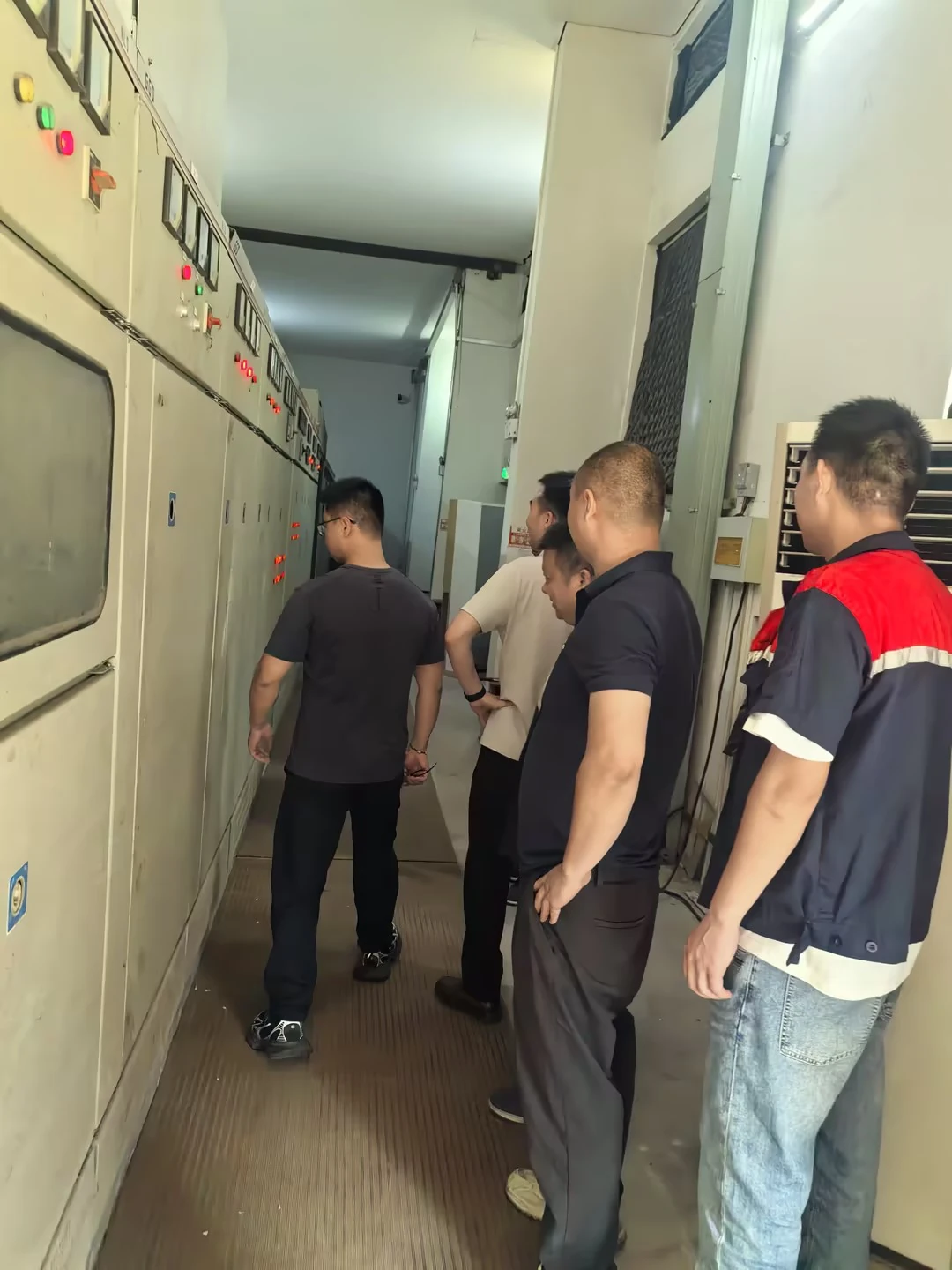
The EHS lead observed three things: reaction time (from alarm to button press), technique (palm-down vertical pressure, not grabbing and pulling), and verbal confirmation ("Zone X power off" spoken loud enough for others to hear).
A 15-minute debrief followed on the spot. Findings:
- Some engineers reacted at about 45 seconds; we want to bring this under 30 seconds — extra practice next month
- One engineer moved too fast without verbal confirmation — SOP refresher scheduled
- An engineer suggested adding fluorescent markings around distribution cabinets for low-light visibility — accepted
One note of honesty: this year's typhoons had minimal impact on our plant. But the preparation happens regardless. Drills don't always get used, but when they do, they save lives — and factories.
Five: Relationship to ISO 45001
We didn't start our safety audits because of ISO 45001. In 2024, when we pursued the certification, we found that the evidence most clauses required was already produced — because we were already doing it.
For anyone preparing for ISO 45001, here's how our weekly practice maps onto the standard. This isn't a template to copy — it just happens that our practice aligns:
| ISO 45001 Clause | Our Weekly Audit Practice |
|---|---|
| 5.1 Leadership and commitment | General manager attends weekly safety meeting and signs audit reports |
| 5.4 Consultation and participation of workers | Employees raise improvement suggestions at weekly meetings (e.g., "add fluorescent markings to cabinets") |
| 6.1.2 Hazard identification | New hazards from weekly walks enter the hazard registry immediately |
| 6.1.3 Legal and other requirements | MSDS, fire code, labor law reviewed each week |
| 7.3 Awareness | On-floor training tied to each weekly audit |
| 8.1.4 Emergency preparedness and response | Typhoon, fire, and chemical-spill drills on rotation |
| 10.2 Incident, nonconformity and corrective action | Find → fix → review → close, tracked weekly |
Our sequence is: practice first, then map to clauses. Not the other way around.
Six: Low-Cost Setup for Small and Mid-Size Plants
This system doesn't require much money.
Tools:
- One A4 printout of the checklist
- Department WeChat group for photo-based issue tracking
- A 30-minute weekly meeting
Roles:
- Fixed shift-lead + warehouse-lead ownership
- General manager attends every week
Cadence:
- Weekly on-floor audit and meeting
- Annual typhoon-season drill
- Annual ISO 45001 external audit
The genuinely expensive parts are the external ISO audit fees and hardware (eyewash station, fire equipment). Those don't go away. The audit process itself costs almost nothing.
Seven: Closing
I'm not claiming we do this well. Every weekly debrief surfaces things we haven't closed properly. What I'll say is this: annual audit plus pre-audit sprint didn't work for us. Moving to a weekly cadence produced slower but far more stable improvement in day-to-day behavior.
The lever isn't the checklist. The lever is whether senior leadership is physically present every week. That single fact seems to matter more than the specific questions asked.
If you're working in EHS or plant management and want to compare notes, I'm open to discussion.
If you're a customer or auditor visiting our plant, we won't hand you a thick binder. We'll walk you to the shop floor and show you this week's audit checklist and the photos of what was found and fixed. You draw your own conclusions.
Chinese version of this article: [https://ace-sz.com/blog/ehs-monthly-audit](https://ace-sz.com/blog/ehs-monthly-audit)
Full checklist PDF available at [https://ace-sz.com/resources](https://ace-sz.com/resources)
Suzhou ACE Sheet Metal Manufacturing Co., Ltd. — precision sheet metal fabrication from Suzhou, China, for semiconductor equipment, medical devices, data centers, and industrial electrical OEMs. ISO 9001 / 14001 / 45001; EcoVadis Bronze.
Learn more: [https://ace-sz.com](https://ace-sz.com)
Related articles: